Evaluating the 3D Fluid Landing Page Template for Modern Web Design Projects
In the rapidly evolving landscape of digital design, visual impact is often the first determinant of user engagement. As audiences become accustomed to high-fidelity interactions and immersive experiences, static or flat design elements are increasingly being replaced by dynamic, organic forms. The 3D Fluid Landing Page Template has emerged as a significant resource in this shift, offering a blend of aesthetic appeal and technical versatility. This template, characterized by its vivid vector backgrounds, neon color palettes, and liquid shapes, provides designers with a robust foundation for creating modern, attention-grabbing web layouts.
Understanding the specific value proposition of this template requires looking beyond its surface-level aesthetics. It represents a convergence of motion graphics principles and vector scalability, addressing common pain points in web development such as load times, resolution consistency across devices, and customization flexibility. For professionals evaluating design assets, it is crucial to assess not just how the template looks, but how it functions within a broader workflow and compares to alternative approaches like CSS-based animations or heavy WebGL implementations.
Core Characteristics and Visual Identity
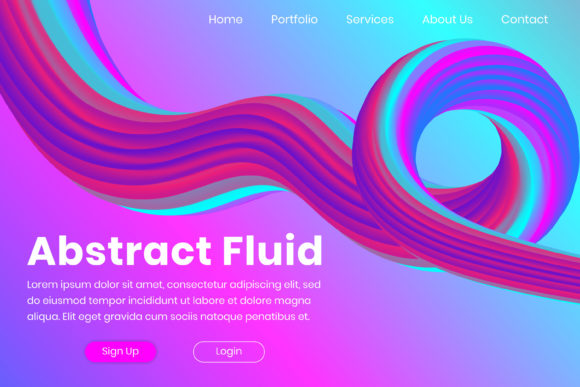
The defining feature of the 3D Fluid Landing Page Template is its use of colorful fluid shapes set against contrasting backgrounds, typically utilizing green and purple hues. These colors are arranged in a neon-inspired layout that creates a sense of depth and movement without relying on complex 3D rendering engines. The design leverages lucid gradients and abstract Memphis-style shapes to create a "funky" yet professional aesthetic. This approach allows the landing page to stand out in crowded digital spaces, such as app stores, SaaS product pages, or creative agency portfolios.
Unlike traditional geometric designs that rely on sharp lines and rigid structures, this template embraces organic flow. The dynamic motion modern wave effect suggests activity and responsiveness, qualities that align well with contemporary brand identities focused on innovation and agility. The background serves multiple purposes: it acts as an HD wallpaper for desktops and mobile screens, including iPhone X dimensions, while simultaneously functioning as a scalable vector graphic for web integration. This dual utility ensures that the visual integrity remains intact whether viewed on a large monitor or a small smartphone display.
Technical Specifications and Workflow Integration
One of the most practical aspects of the 3D Fluid Landing Page Template is its file structure and compatibility. Designed primarily for Adobe Illustrator, the template includes AI files alongside JPG and PNG exports. This format choice is significant for designers who prioritize non-destructive editing. Working with vector files allows for infinite scalability, meaning the fluid shapes can be resized from a favicon to a billboard without any loss in quality. This is a distinct advantage over raster-based templates, which often suffer from pixelation when scaled up.
- Resolution and Color Mode: The template is provided at a high resolution of 72 DPI in RGB color mode, sized at 3000×2000 pixels. While 72 DPI is standard for screen-based media, the vector nature of the core assets means that effective resolution is effectively unlimited. The RGB mode ensures vibrant, accurate color reproduction on digital displays, which is critical for maintaining the neon and gradient effects.
- Customization Ease: The AI file is structured for quick and easy customization. Designers can modify individual layers, adjust gradient stops, and rearrange Memphis shapes to fit their brand guidelines. This modularity reduces the time required to adapt a generic template into a bespoke design solution.
- File Inclusivity: By including both source (AI) and exportable formats (JPG/PNG), the template accommodates different stages of the design process. Initial conceptualization can happen in Illustrator, while final assets can be exported for web use or presentation decks.
Comparative Analysis: Vector vs. Code-Based Animations
When evaluating the 3D Fluid Landing Page Template, it is helpful to compare it against code-based alternatives, such as CSS animations or JavaScript libraries like Three.js. Code-based animations offer real-time interactivity, where elements respond directly to mouse movements or scroll events. However, they often require significant development resources, specialized coding skills, and can negatively impact website performance if not optimized correctly.
In contrast, the vector-based approach of this template offers a lightweight alternative. Because the fluid shapes are pre-designed vectors, they do not require heavy computational power to render. This results in faster load times and a smoother user experience, particularly on mobile devices with limited processing capabilities. The trade-off is a reduction in real-time interactivity; the "motion" is implied through design rather than executed through code. For many projects, especially those requiring strong visual branding over complex interactive mechanics, this trade-off is favorable.
Another point of comparison is static imagery. While static images are the simplest to implement, they lack the psychological pull of perceived movement. The 3D Fluid Landing Page Template bridges this gap by using visual cues—such as overlapping gradients and flowing curves—to suggest motion. This creates a more engaging experience than a flat image without the overhead of animation scripts. It is an ideal middle ground for businesses that want a modern look but lack the budget for custom front-end development.
Use Cases and Strategic Fit
Determining when to utilize the 3D Fluid Landing Page Template depends largely on the goals of the project. It is particularly well-suited for industries that value creativity, technology, and visual sophistication. Startups in the tech sector, creative agencies, and lifestyle brands often find that the neon and fluid aesthetic aligns with their messaging of innovation and dynamism.
The template’s versatility extends beyond web design. Its high-resolution vector nature makes it an excellent asset for presentations, pitch decks, and marketing materials. The ability to scale the background to any extent ensures that slide decks maintain a professional appearance regardless of the projection size. Additionally, the inclusion of mobile-optimized dimensions makes it suitable for social media banners and app store screenshots, providing a cohesive visual identity across multiple platforms.
However, there are limitations to consider. If a project requires strict adherence to minimalist corporate branding, the vibrant neon colors and complex fluid shapes may feel too distracting. Similarly, if the primary goal is to showcase data visualization or complex interactive tools, a simpler background might be more appropriate to avoid visual clutter. In these cases, a monochromatic or subdued template would be a better fit.
Decision Factors for Designers
For designers choosing between various landing page resources, several factors should guide the decision-making process. First, consider the target audience. Younger demographics, particularly those aged 20–50 who are digitally native, tend to respond positively to bold, colorful, and modern aesthetics. The 3D Fluid Landing Page Template caters directly to this preference.
Second, evaluate the technical constraints. If the website relies on a Content Management System (CMS) that does not support heavy JavaScript libraries, a vector-based template is a safer bet. It ensures compatibility and stability without risking site speed penalties. Third, assess the customization needs. If the brand has very specific color requirements or structural layouts, the modularity of the AI file becomes a critical advantage. The ability to tweak individual elements ensures that the template can be tailored to fit unique brand guidelines.
Finally, consider the long-term maintenance. Vector files are future-proof in terms of scalability, whereas raster images may become obsolete as screen resolutions increase. The 3D Fluid Landing Page Template’s reliance on Adobe Illustrator ensures that the assets remain editable and adaptable as design trends evolve. This longevity adds value to the initial investment, making it a sustainable choice for ongoing marketing campaigns.
Conclusion
The 3D Fluid Landing Page Template offers a compelling solution for designers seeking to combine visual impact with technical efficiency. Its strengths lie in its scalability, ease of customization, and ability to convey motion through static vector forms. While it may not replace the need for complex interactive code in highly specialized applications, it serves as a powerful tool for creating memorable, modern web experiences. By understanding its features, limitations, and ideal use cases, professionals can make informed decisions about when this template fits into their design strategy, ensuring that their digital presence is both aesthetically pleasing and functionally sound.